
History
Founding (1975–1976)
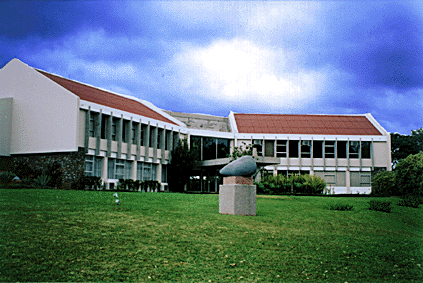
CIAPA was founded in the mid-1970s by Samuel Z. Stone, together with colleagues from the University of Costa Rica, out of a shared interest in strengthening social science research and public policy debate in Central America during a turbulent period for the region. Stone secured a partnership with Tulane University and established the center under its auspices. The two institutions signed a formal agreement on March 18, 1975. Costa Rican President Daniel Oduber inaugurated CIAPA's offices on April 23, 1976. Read Samuel Stone's inaugural speech (PDF, in Spanish) from that ceremony.
Founding members
CIAPA brought together an ideologically diverse group of scholars from the University of Costa Rica's political science department, including Rodolfo Cerdas, Jaime Daremblum (later Costa Rica's ambassador to the United States), Ronald Fernández, and Stone himself. They were later joined by Constantino Urcuyo, currently the longest-serving member of the organization.
Early years and growth
From 1976 to 1980, CIAPA and Tulane co-hosted annual Central American Conferences on the investment climate in New Orleans, and Tulane ran summer programs at CIAPA's campus in Costa Rica. Costa Rica's geopolitical importance during the late 1970s and 1980s brought significant USAID funding, which supported campus development and the creation of an endowment.
Independence and restructuring
Currency devaluation and rising costs put pressure on the USAID-funded endowment. In the early 1990s, Stone considered merging CIAPA with Tulane's Center for Latin American Studies, but ultimately chose a different path: he secured private foundation funding to establish the independent CIAPA Support Trust.
Renewed partnership with Tulane
After Stone's retirement, Ludovico Feoli worked in partnership with Tom Reese to rebuild CIAPA's relationship with Tulane. Joint conferences and study-abroad programs for Tulane resumed in 2000, and a 2009 Memorandum of Understanding created the Center for Inter-American Policy and Research (CIPR), with CIAPA becoming Tulane's research and training center in Costa Rica. The MOU was renewed and expanded in 2024.
CIAPA today
The institution now works primarily through fellowships for pre- and post-doctoral, mid-career, and senior researchers rather than a permanent faculty. Following Samuel Z. Stone's death in 2006, the CIAPA Support Trust was renamed in his honor. In 2024, CIPR launched the Central American Politics Consortium to foster scholarly exchange and policy work on the region.